One Great Content Piece Beats Ten Mediocre Ones
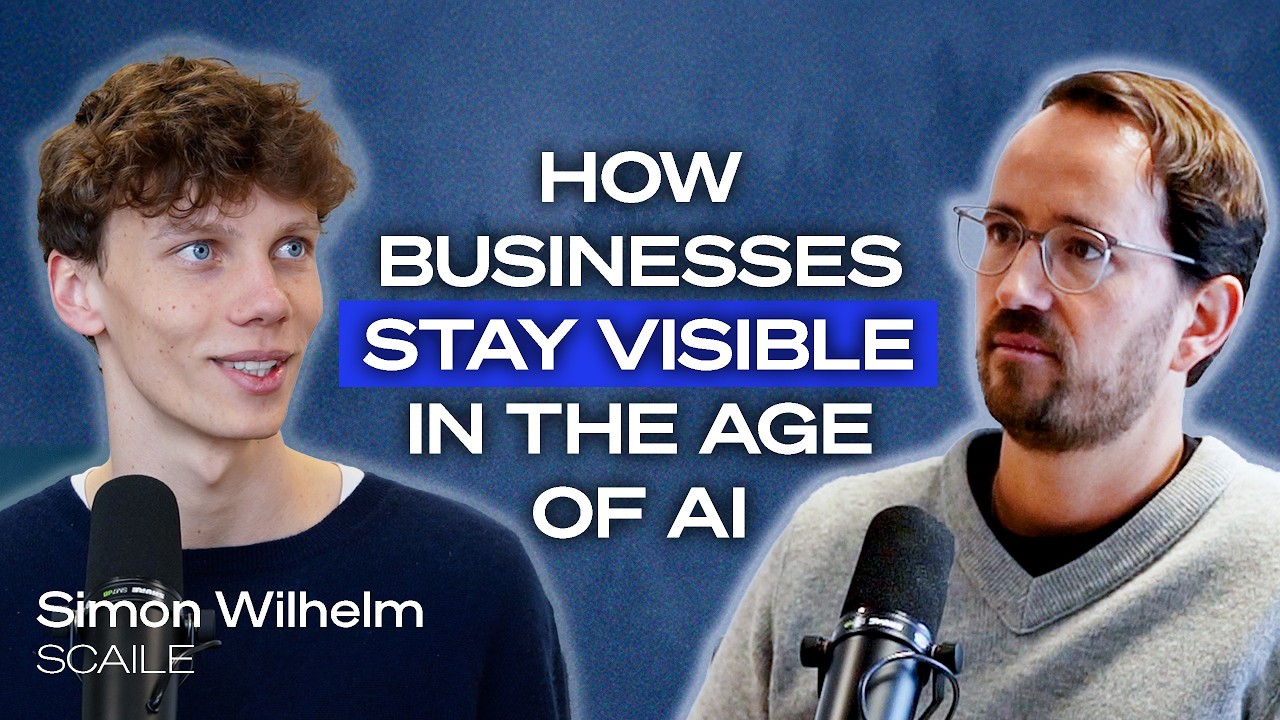
Simon Wilhelm sits down with Daniel on the Tamre Podcast to explain why the AI search era rewards quality over quantity, how SCAILE went from zero to near half a million ARR in five months, and why showing up in ChatGPT does not mean you show up in Perplexity.

Quality Is the Whole Game
That is the line SCAILE CEO Simon Wilhelm came back to repeatedly during his 40-minute conversation with Daniel on the Tamre Podcast: one truly great piece of content outperforms ten mediocre ones, every single time. It is the principle that has carried SCAILE from a venture-studio idea in October 2024 to almost half a million Euros of annual recurring revenue five months later, with enterprise clients like Beurer and Impossible Cloud and scale-ups like Lyceum Technologies on the roster.
The temptation in any AI-search programme is the opposite. The tooling makes it cheap to publish, so the instinct is to publish often. Simon's argument is that volume without depth gets you penalised by Google, ignored by LLMs, and burned by the next spam update. The work that wins is unique, technically clean, and answers a real question a real buyer actually asked.
This article expands on the main threads from the episode and turns them into something a marketing leader can act on this quarter.
SEO, AEO, GEO: One Discipline With Different Names
The terminology around AI search is still being settled. Simon's quick guide:
- SEO (Search Engine Optimization) is the classic discipline: publishing content on your site that targets keywords people type into Google, then accumulating signals like backlinks and domain authority so your page ranks high in the ten blue links.
- AEO (Answer Engine Optimization) is the work of making sure you appear in the AI summary boxes Google now stacks above the blue links, the so-called AI Overviews. Google's own CEO has signalled that AEO is the preferred term.
- GEO (Generative Engine Optimization) is the broader work of being cited and recommended inside ChatGPT, Perplexity, Claude, Gemini, and the rest of the generative chat surfaces.
The important thing Simon makes clear: if you do SEO properly today, you are already doing most of AEO and GEO. The disciplines diverge in their measurement and in the last 20 percent of optimisation, but the foundational work, original, structured, citation-ready content, is the same. Stop thinking of them as competing budgets and start thinking of them as one content programme with three measurement surfaces.
Why Timelines Compressed From Months to Days
Traditional SEO operated on a brutal time horizon. Publish today, wait three to five months to see whether Google ranks you. That cycle made experimentation expensive and discouraged smaller teams from competing at all.
In the GEO and AEO era, that window has compressed dramatically. Simon's data point from working with clients: the first measurable impact lands in ten to fourteen days. Provided the page is technically clean enough to be crawled, the content is high quality, and the facts check out, LLMs and AI Overviews pick it up fast, because they are constantly re-indexing to keep their responses fresh.
That changes the maths of content investment. A test you used to need a quarter to evaluate, you can now read in two weeks. The cost of being wrong drops, the cost of doing nothing rises, and the practical implication is that the conservative posture, waiting to see what others do, is the most expensive option on the table.
The Anatomy of a Citation-Ready Page
What makes a single piece of content earn its keep in this new world? Simon walked through the technical checklist:
- Genuinely unique angle. Not a rewrite of what is already on page one. LLMs are trained on what already exists, so they reward content they have not seen before.
- Real questions buyers actually ask. Pulled from your sales calls, support tickets, Reddit threads, and gutefrage-style forums. Not keyword-tool guesses.
- Clear structure. Headings, subheadings, lists, tables, internal links. The same things that help a human skim a long page also help an LLM extract a clean answer to cite.
- A named human author with a real presence and track record, not "the editorial team."
- Factually accurate. LLMs penalise pages that disagree with the wider web on hard facts, even when the page itself is well written.
- Lives in a content cluster. A single article rarely moves the needle. A coordinated set that covers a topic from multiple angles wins citations consistently.
The trap most teams fall into: they nail one or two of these and miss the rest. The discipline is doing them together, every time, even when the publication calendar is screaming at you to ship.
The Refresh Move Most Teams Miss
Simon dropped a tactic that is worth its own paragraph. Before publishing new content, refresh what is already on your site. Take an article that is twelve months old, update the data, layer in the structural elements (internal links, tables, fresh meta description, refreshed image alt text), then ping the URL in Google Search Console.
The reason it works: an article that has been indexed for a year already has accumulated trust signals. Refreshing it lets you bank all that historical authority while still being treated as current. Compare that with publishing a brand new piece that starts from zero authority and takes weeks to climb.
For teams looking at a backlog of stale content, this is the highest-yield first move. Refresh what you already own before writing anything new.
ChatGPT Is Not Perplexity. Perplexity Is Not Google.
A common mistake: assuming visibility transfers between AI surfaces. It does not. Showing up in ChatGPT does not mean you show up in Perplexity, and a Perplexity win does not buy you Google AI Overview presence.
Each surface ranks differently:
- ChatGPT relies heavily on Google search results for its Query Fanout retrieval. When Google changed its default results-per-page from 100 to 10, Reddit threads buried on page 56 stopped being cited inside ChatGPT, and Reddit's share of ChatGPT citations dropped overnight.
- Perplexity uses its own crawl and weighting, and is less sensitive to Google's ranking shifts.
- Google AI Overviews apply Google's own SEO logic but layer on extractability heuristics: how easily can a passage of your page be pulled as a standalone answer.
The practical move: start with the foundations that lift you across all three (uniqueness, structure, facts), then run targeted optimisation for the surface where your buyers spend the most time. Measure each surface separately. Do not assume one number describes them all.
The Discovery Surface Goes Beyond Your Blog
Your website is one citation source. It is not the only one, and in many cases it is no longer the dominant one. Simon called out YouTube specifically: it has quietly become one of the most-cited surfaces in AI search, because the transcripts are uniquely human content that the LLMs cannot generate themselves.
That has implications for how content teams think about their footprint:
- Publishing the same insight as a blog post, a LinkedIn article, a YouTube interview, a Reddit comment thread, and a podcast episode is not duplication. It is coverage across the surfaces an LLM samples from.
- Consistency across those surfaces is what stops LLMs from getting confused about who you are and what you do. Inconsistent positioning across channels is a citation killer.
- The most valuable content is the kind that proves a human said it. Interviews, founder posts, and original case-study writeups outperform anonymous editorial copy by a wide margin.
This is exactly the discipline behind SCAILE's own publishing rhythm, including the news section you are reading right now.
The Numbers Behind The Pitch
Three concrete results Simon shared in the episode:
- LipoCheck (HealthTech app for lipedema patients): in a single month, SCAILE-driven organic search was responsible for over 80 percent of the app's App Store downloads. Organic monthly website visitors grew from 5,000 to 40,000. Read the full breakdown in the LipoCheck case study.
- Lyceum Technologies (GPU rental for AI training): 15x traffic uplift in a regulated B2B SaaS category.
- SCAILE itself: roughly €550K of ARR added in the five months since the company pivoted from a venture-studio model to a pure AI visibility focus in October.
The pattern in the numbers is worth dwelling on. SCAILE's biggest wins are in categories that look hostile to fast SEO progress: regulated health, complex enterprise infrastructure, narrow technical buyers. Those are exactly the categories where one truly thoughtful piece of content can outperform a year of generic writing, because the buyers asking those AI questions are not looking for filler.
How SCAILE Sells (Hint: Almost Entirely Inbound)
When asked about go-to-market, Simon was direct: SCAILE has been close to 100 percent founder-led sales, almost entirely inbound. The channels that worked:
- In-person events and conferences. Higher ROI per hour than almost any digital channel for an early-stage B2B brand.
- LinkedIn personal content. Not product posts. Personal stories, lessons learned, things the founder is wrestling with. Approachability converts.
- Word of mouth from existing customers. Often inside the same group, where one customer's C-suite mentions SCAILE to a peer at the next board meeting.
What did not work: paid Google Ads, which burned budget without generating qualified pipeline. A useful data point for any founder weighing where to put first marketing Euros.
How An AI-First Team Actually Works Inside
A side observation that stood out from the episode: SCAILE spent over €80,000 on Cursor and Claude Code in twelve months across just three people. The team has effectively moved into the terminal as its primary working environment, with AI tools collapsing the engineering effort needed to ship product, run experiments, and iterate on client work.
The lesson is not "buy more AI tooling." The lesson is that the unit of leverage in a modern team has shifted. Three people with the right AI stack now ship what would have required a much larger team two years ago. Companies that have not adjusted their staffing model to reflect that are accidentally paying for slowness.
Frequently Asked Questions
How fast do AI search results actually move now?
For a site that is technically clean and produces genuinely original content, the first measurable impact in AI Overviews and LLM citations lands within ten to fourteen days. That is dramatically faster than the three to five month window traditional SEO required, and it changes how aggressively you can test content angles.
Should I rebuild my SEO programme as an AEO programme?
No. Do them together. Most of the foundational work, original content, clear structure, factual accuracy, technical site health, contributes to all three of SEO, AEO and GEO. The disciplines only diverge in the last twenty percent of optimisation. Treat them as one content programme with three measurement surfaces.
Is showing up in ChatGPT the same as showing up in Perplexity?
No. ChatGPT relies heavily on Google search results in its retrieval step. Perplexity uses its own crawl and ranking. Google AI Overviews use Google's logic with extra extractability heuristics. Visibility on one surface does not transfer to the others. Measure each separately.
What is the single highest-yield first move?
Refresh existing content before writing new content. An article that has been indexed for a year already has trust signals. Updating its data, structure, and metadata, then re-submitting it via Google Search Console, captures all that historical authority while resetting the freshness signal.
Does AI search work for small companies and startups, or only large brands?
It works particularly well for smaller companies. LLMs reason from content quality, not from inbound link history or domain authority accumulated over a decade. A well-positioned startup with truly original content can outrank a slow incumbent in AI surfaces in a way that was simply not possible in classic Google SEO.
What channels matter outside our blog?
LinkedIn articles, YouTube content, Reddit threads, and original guest commentary all contribute to your AI search footprint. YouTube in particular has become one of the most-cited surfaces because transcripts are uniquely human content that LLMs cannot synthesise. Consistency of positioning across these surfaces also matters: inconsistent messaging confuses the models.
Where To Go From Here
The conversation closes on a useful 30/60/90 framing for marketing leaders deciding what to do this quarter:
First 30 days. Audit your existing AI visibility. Use a tool like the SCAILE AI Visibility audit or Health Check to see how you currently appear across ChatGPT, Perplexity, and Google AI Overviews. Pick the three queries that matter most to your pipeline and benchmark where you stand.
60 days. Refresh your existing top-performing content with the structural checklist above. Internal links, tables, named authors, fresh metadata, factual updates. Re-submit via Google Search Console. This is the highest-yield first move.
90 days. Build a content cluster of three to five connected pieces around your single most important buyer question. Publish them with proper structure, real human authorship, and original perspective. Measure citation rates on all three AI surfaces, not just Google.
The pitch from the episode in one sentence: in an era when AI assistants answer most buyer questions directly, the only durable competitive advantage is being the answer the model picks. SCAILE exists to make that happen at scale, with the same content engine that is built into this site.